Tuesday, January 07, 2014

On rape

A few weeks ago I caused a fuss on Facebook by sharing a post which suggested that the responsibility for women getting raped lies with the men who rape them. Some (male) readers disagreed with that statement, suggesting that women shared the responsibility for not being raped, and that they could avoid it by changing how they dressed or staying away from certain parts of the city. One reader said that women's duty of self-care should prohibit them going to certain areas of the city, just as blacks wishing to avoid harm should not attend KKK meetings.

Here's my response.

<tl,dr> Bullshit: women are raped because men rape them, not because of where they go. Women are raped because men rape them, not because of what they wear. To say anything else exonerates men from responsibility for their actions. </tl,dr>

And now, the long version:

I object to those statements, as did most (notably: all female) commenters, for several reasons. First and foremost, their words make rape an accepted facet of urban life — on a par with traffic accidents or dogshit on the pavement. Stating that rape can be avoided by not going downtown (or wherever) is a statement that women who do go downtown should expect to be raped there (as if the men in that area were exempt from moral and legal standards).

No part of any city should ever be off-bounds to any citizen. Anything less than that is an intolerable civic failure which must be corrected.

Furthermore, the KKK is a false analogy: city streets are not private places, and walking to one's car is different from attending a meeting behind closed doors. It would be very difficult for a black man accidentally to walk into a session of the KKK: there aren't many such sessions, and by and large they do not take place outdoors on city streets, and when they *do* in the form of a rally, the huge burning crosses are a pretty clear warning. Rapists don't carry warning signs with them.

It's also simply incorrect: rape is not about geography. Women are raped in parks and on riverbanks, in elevators, in shopping malls and in parking garages and in university libraries, in airports and on trains, in nice suburbs and in gentrified "artistic" neighbourhoods.

The second statement was that women who dress "provocatively" should expect to be raped. I'm sorry but I'll have to ask you to explain what that word means here. I know what provocation is, and I don't see how it applies. Did her short dress insult your mother? Does her sexy blouse belittle your golf score? Was her visible panty line rude about your wife's cooking? This too is nonsense, and men hearing it should feel insulted because it states that you are unable to control yourselves: one glimpse of a thigh and the inner barbarian *must* rage out to perform violence. Are you really that weak-willed, guys?

Here's an exercise for anyone who thinks that sexy clothes cause rape: Have you ever seen a woman who was dressed (in your opinion) in a way that was "sexy" or "provocative"? I'm willing to guess that the answer is yes. Question: did you rape her? I'm willing to guess that the answer is no. Why not? If a woman's clothing really does inevitably causes men to rape them, then why did *you* not rape her? Think about that.

It's also simply incorrect: dull clothing is no protection. Women are raped wearing sweatpants and t-shirts. Women are raped while wearing jogging outfits. Women are even raped while wearing head-to-toe burkas that reveal nothing but their eyes! Google "what I was wearing when I was raped" if you want to see some examples. Here's one to start with.

My neighbour was raped in her own bedroom by a man who scaled the scaffolding on the next house along, jumped onto her balcony and broke in.

Tell me, please, what should she have worn to avoid that? Which part of town should she have stayed away from?

Labels: , ,

Saturday, August 08, 2009

DFW on worship and truth

Not actually from "Infinite Jest," but quite marvellous nonetheless.
The only thing that's capital-T True is that you get to decide how you're going to try to see [life, the universe and everything]. You get to consciously decide what has meaning and what doesn't. You get to decide what to worship…

Because here's something else that's true. In the day-to-day trenches of adult life, there is actually no such thing as atheism. There is no such thing as not worshipping. Everybody worships. The only choice we get is what to worship. And an outstanding reason for choosing some sort of God or spiritual-type thing to worship — be it J.C. or Allah, be it Yahweh or the Wiccan mother-goddess or the Four Noble Truths or some infrangible set of ethical principles — is that pretty much anything else you worship will eat you alive. If you worship money and things — if they are where you tap real meaning in life — then you will never have enough. Never feel you have enough. It's the truth. Worship your own body and beauty and sexual allure and you will always feel ugly, and when time and age start showing, you will die a million deaths before they finally plant you. On one level, we all know this stuff already — it's been codified as myths, proverbs, clichés, bromides, epigrams, parables: the skeleton of every great story. The trick is keeping the truth up-front in daily consciousness. Worship power — you will feel weak and afraid, and you will need ever more power over others to keep the fear at bay. Worship your intellect, being seen as smart — you will end up feeling stupid, a fraud, always on the verge of being found out. And so on.
Taken from that now-famous commencement speech at Kenyon College in 2005. Read it here before it disappears behind a pay-wall.

Shabbat shalom, my dears.

Labels: , , , ,

Thursday, April 02, 2009

Micro-career

Hanging about in the office, waiting for a software update to finish.

Let me bring to your attention something quite wonderful, and spin on what I've been thinking about since seeing it. First, the viewing: turn your speakers on and the volume up, and listen to Kutiman's collected works. Do it now, please; it's OK, I'll wait. (If you're in a hurry, numbers 1, 5 and 8 are the must-see's.)

Now have a look at the singer/songwriter featured in the fifth of those, Dadasarah. She's a housewife with a little kid, who happened to study voice in college; she's a woman with a videorecorder, writing and singing her own material for her own satisfaction.

Her twenty videos have been viewed 58,007 times as I'm writing this. Fifty-eight thousand times. Most of her videos get five-star ratings, the rest four-and-a-half.

Kutiman's eight videos have been viewed 1,696,659 times as I'm writing this. Let's say that again nice and slowly: One point seven million times. Most of his videos get five-star ratings, a few four-and-a-half, and one ugly duckling got a mere four stars. He has a fanbase whose size and enthusiasm many "established" artists would envy.

Two quite different people making music — principally for their own amusement — in quite different ways. They have something interesting and very significant in common: They are getting it presented to us, and we are lapping it up.

I think that home-brew distributed on the Internets is the future of music-making.

There is a new kind of career to be had here, which wasn't possible before. In the bad old days when music was a physical object, it was said that there were only two kinds of money that a musician could make: None at all; or More than you would ever believe possible. Getting people's attention, putting the product in their presence, was expensive as all hell. It took a team of a dozen people to bring physical music to the attention of a possible paying audience, which is why the labels took such a large slice of the pie.

Zero-cost bandwidth and immaterial distribution change all that. Kutiman and Dadasarah distribute for free, thanks to youTube; I am bringing them to your attention for free, thanks to Blogger. The only thing missing is a way to turn their talent and our attention into an income stream, but given the size of these viewing figures that is surely only a matter of time.

And when that happens, it will be possible to make a decent living with a micro-career in music. You won't be able to live the rock-star lifestyle — let's be honest though: don't we all know that rock stars trash their hotel rooms because they are lonely, bored and unhappy? — but you will make enough money to continue making music. And for people like Dadasarah and Kutiman, that is what it's all about.

If Apple continues to be as smart as they have been, they will soon let "ordinary people" post music for sale on iTunes. What will happen when Dadasarah and Kutiman get there? Say that Apple gives them half of the dollar that they charge for songs (because there is no record company's share to pay); say for the purposes of argument that they would get fifty cents per song.

If half of the people who love Dadasarah's songs had bought one of them on iTunes, she would have earned around 14.5 thousand dollars. If an eighth of the people who love Kutiman's songs had bought one of them, and if he had then paid out two-thirds of the income as royalties to those whose videos he sampled, he would still have earned around 35 thousand dollars.

This is the future, people. And I for one can't wait for it to get here.

Labels: , , , , ,

Sunday, November 02, 2008

Seth on losing

Seth Godin wrote a few days back about different ways of winning and losing:
Actual conversation at a local shoe store: "Do you have dress shoes in a size 6?"

"No, I'm sorry we don't."

"We're from out of town. Do you know any place we can get some?"

"I'm sorry I don't. Perhaps you'd like some in a size 8?"

Now, what are the chances that someone who wants a size 6 is going to buy an 8? Zero. The game is over. You lost. […]

It seems to me that this is the perfect opportunity to be a statesman. This is when you earn the right to be seen as a trusted advisor, not a self-interested shill. Two months or two years from now, when you interact with that person or organization again, we'll remember that you were the one who spoke up on behalf of the competition, the one who helped us find a better fit, the clearly disinterested advisor who helped us choose between the two remaining good choices.
This is absolutely true, it has happened before my very eyes.

The best salesman (highest-volume and highest-profit) at the Great Big Computer Company was a guy who would recommend products from the opposition when they were better suited to his customers' needs.

Do you think his customers trusted him? Do you think they called him back, and called him first, next time they needed something?

(Management at GBCC was furious, of course, but what could they do? He made nearly a fifth of the company's turnover.)

You can win in the short-term by forcing people to do what you want, to buy what you sell; but the way to win in the long term is to be the enabler of goodness.

Two down, twenty-eight to go.

Labels: ,

Monday, May 05, 2008

How the future doesn't look

It's a fine summery Monday midday in Toronto, 12:52 pm at present whatever Blogger might try to tell you. The weather has changed: after two days of cold and rain, today is sunny and warmish (16°C) with a gentle breeze and only few decorative clouds.

I'm alone at home (in my parents' house): Sis and BIL are downtown seeing friends, Niece and Nephew are at the Science Centre, parents are shopping. I have taken advantage of their absence to open up windows front and back, to get some fresh air into the house. I find the recycled air of these tightly-sealed North American houses unpleasant: it feels used, stale, flaccid somehow compared to the fresh crisp vitality of the air outside. I can hear birdsong — such a profusion and variety of birds here! — and airplanes, a lawnmower and the vague dull background roar of traffic on the Don Valley Parkway, which together were the soundtrack of my childhood. One thing is sorely missing though: the sound and smell of the row of poplars that stood at the back of our property. Ah well.

The neighbourhood has not changed much visibly, many houses are still inhabited by families I knew forty years ago. In some cases, the parents moved out and left the house to the next generation (my generation) who are now raising children here; some others simply never left home. One can't even buy a cardboard box in the gutter for under C$199,000 these days, let alone a proper house where one might raise a family. There are apartments and condominia going up all over downtown, which is generally a good thing, Jane Jacobs was entirely right about that, but they start at C$ half a million for a one-bedroom flat. Who the hell buys or rents them, and how do they pay for it?

The better question is: Where on earth does everyone else live? The answer is, sadly, "In a bedroom suburb 90 minutes by car away from their jobs downtown." This is not a model for the future. Oil is running out (in case you hadn't heard), and the automotive suburban lifestyle will die with it. How do you think people will survive in so-called "communities" where there are no shops? How will you get to the big-box store by the highway intersection when there is no gas to put in your car? For that matter, the big boxes won't be there: how will WalM*rt and the rest survive when the price of diesel makes their warehouses on wheels as expensive as the brick-and-mortar warehouses of their competitors? They will die before peak oil really hits, because their sole justification for existing is their low price: people are willing to buy shit from them because it is cheaper than non-shit, but who would still shop at WalM*rt if their shit were the same price as other stores' higher-quality goods? The big-box stores are dead, take that as a given. The Internet shopfronts like Amazon, who are really just negotiators between you and somebody else's warehouse on wheels, will die immediately after from the same cause: their business model also depends on cheap and plentiful fuel.

I am extremely pessimistic about the future of North America late-phase free-market globalized capitalist democracy, I'm sorry to say, not because the problem is insoluble but because I see no willingness to admit that it exists at all. Hard rains are coming, folks, and I'll tell you right now, for free, that neither prayer nor technology will provide a solution. Nor will the kind of eyes-tightly-shut denial that is currently being practiced by almost all politicians and media.

The coming crisis is not about the kind of fuel we pour into our cars, that is a technical matter (albeit one with wide-reaching social, environmental and global-political side effects, obviously).

The root problem is the car itself: the kind of lifestyle it forces (apparently...) us to live and the kind of national economy it requires (apparently...) us to support. How and with what will we replace a society based on the immediate gratification of childish whims and on private, individual mobility? Because these are not sustainable in the long term, probably not even in the middle term, and the sooner we begin to face this problem the more likely we are to solve it without falling into chaos and bloodshed.

Our desires and our lifestyle must change, if we wish to save the rest of what we now call "civilization."

Thus endeth the lesson.

Labels: , , , , ,

Monday, October 15, 2007

qa0ßßß0

Monday, work day, alone in the house but for cat and dog. Parents and friends are en route (separately) to Toronto; cousins have dispersed in every compass direction but south; Sis, BIL and Nephew are at work, Niece is back at the university lazing about studying.

Twenty-two of us met yesterday for a formal brunch in the Hotel Sask, very pleasant. Afterwards, Physically Distant Cousin and I went on a pilgrimage to Rouleau, better known as Dog River. There wasn't much to see, alas, as filming was finished for the year and the gas station/café was (literally) boarded up tight and all possible stealables locked away. A lovely day out nonetheless, photos will be posted later in the week.

PDC's daughter is about to graduate from high school, and is wondering what to do with her life (she's not yet eighteen). I suggested that she might take a year or two off to see a bit of the world and consider what if anything to study. There is a certain amount of parental pressure influence to continue straight on into university; I countered that taking a generic BA course for its own sake is a poor investment of time if she doesn't know what she wishes to study. Better to spend a little time exploring herself and narrowing down the possibilities.

Conan has just walked across the keyboard, renaming this piece. I'm inclined to let his contribution stand.

I walked to the local Chapters store at the edge of town this morning, where I spent a pleasant 90 minutes snuffling and nosing about. It's odd that I can spend hours (literally) in a bookshop, but am seldom longer than twenty minutes in the library. Managed to restrict myself to six books, but only because four others that I was specifically searching for weren't available. Megastores like this are an odd combination of delight and frustration: they have so many (presumably) wonderful books, yet they almost never have the one particular book that you wanted.

I'd forgotten during my years in Germany, how much of English so-called humour is based on cruelty, on harsh mockery and abusive, bitter put-downs. I found speaking to my father's cousin quite distasteful; on the other hand, I have to award him points for being the only representative of my father's family who could be bothered to attend. [Updated: in fairness, those that didn't have school-age children or are themselves teachers, so it would have been pretty difficult to get away—just to have lunch together.]

This may be the last post for a while, as tomorrow will be spent travelling and Wednesday will be spent sleeping. Take care, be good to yourselves and each other.

Labels: , , ,

Wednesday, September 05, 2007

On writing about dreams

The trouble with writing about dreams, is that your thoughts about the dream, the words you find to describe it, thereafter contaminate your memories of the dream.

One remembers the act of writing, the thoughts and images that one had while trying to recall and explain the dream, with at least the same clarity and vividness as the dream itself. It's obvious that this could happen: isn't a dream just thoughts and images?

I was shocked to read Zhoen's comment that the person behind the dream-character that I had called "my lost lover" might have been a child. Characters in dreams are not necessarily whom they appear to be: according to some analysts many dream characters are aspects of oneself that don't get expressed in daily life. I know that and knew that at the time, so what exactly was so disturbing? I think it was the juxtaposition of the words "child" and "lover," strengst verboten and rightly so.

So I reconsidered: where did that word "lover" come from? was it really in Monday night's dream, or rather in Tuesday's blogging? (This is the point at which I realized the extent to which my memory of describing the dream overlays my memory of the dream itself.)

There was certainly nothing (overtly) sexual in the dream, even the nakedness was childlike, Adam-and-Eveish. "Lover" is clearly the wrong word; in the dream she was someone whom I had valued as a dear friend and lost contact with, not someone with whom I had had a sexual relationship. The emphasis should have been on the word "lost."

Bygones. Next up.

In other news I switched the central heating on this morning. Winter has arrived, to mingled cheers and boos.

Labels: , ,

Saturday, August 04, 2007

First thoughts about Second Life

(Home and happy and far too tired for thought. So here's a blog entry that I've been writing in bits for a while. There'll be a real post about Hamburg and other stuff tomorrow, promise.)

I have had a Second Life for a few weeks now, not that I spend much time there. (In case any readers should happen to be or become 2L'ers: you can guess my given name there, and my surname is "Watanabe;" do come up and say hello.)

It took me a long time to start, because I couldn't see the point (and still don't, really): "So you dress up and walk around and talk to people, and buy things, but that takes money so you have to work for a living? Gee, that sounds kinda familiar." My inner cheapskate was also put off by the constant talk in articles and reviews about buying this and paying for that, but it's a red herring. One can choose an avatar and walk around etc etc for free; you only need a paying membership if you want to own property.

It's a strange and surprising place, though less of both than I'd expected and hoped. The first surprise is how few people are there at any given time, the islands I've seen were universally empty. I have yet to land on a place that had as much activity as the newbie getting-started tutorial spaces. The second surprise, which is closely related to the first, is that it's deadly dull most of the time. There is acres of stuff stacked up into the stratosphere (avatars can fly! easily the best part of 2L) but most parts of most islands seem to be predominantly private or commercial.

The third surprise is how few avatars are actually interesting to look at, and how few basic types there are. Any big-city bus contains more diversity of height, weight, age, skin colour and prettiness than all that I've seen of Second Life. This is a feeling that builds up over time, one's first impression is of great diversity because this tall thin beautiful long-haired perky-breasted white 20-something has a cat's ears and tail, whereas that tall thin beautiful long-haired perky-breasted white 20-something has an eagle's wings. It takes a while to spot that they are all tall thin beautiful long-haired etc. Nobody is old, weak, worn, tired, sick or even fat or ugly; nobody is not a successful and productive free-market capitalist democrat.

There are two standard body-types that one meets on every street corner in Second Life. The commonest male ego-gratification-body is the Russian-Mafia bodyguard: biceps as thick as your thigh, shoulder-breadth nearly half of his height, seventy percent of body mass above the diaphragm, cranial capacity less than his shoe size, and a phallic bulge that would intimidate a donkey. The commonest female ego-gratification-body is the Barbie doll: enormously tall and skinny, legs nearly two-thirds of her height, waist narrower than the male's biceps, no hips, would weigh less than fifty kilograms were it not for her enormous but perky breasts.

Body type as wish fulfillment, one might say, and more power to your fingertips, were the bodies not so un-humanly perfect, so insulting to those of our First Life. I haven't seen many experienced 2L'ers yet, for geographical reasons I know mostly newbies like myself, but still I am inclined to very much doubt that one percent of avatars look anything at all like their owners. Which is fine in itself: it's a fantasy world, go ahead and fantasize. What came to disturb me is how relentlessly similar the core of the fantasy is: almost all avatars look like the same one percent of the real world's population.

Yawn and yuck to them. I can't help thinking that wearing such a body in Second Life must make one dissatisfied with one's real body, with its petty flaws and disobediences.

I decided to rebel against this by modifying my avatar to be realistically un-beautiful—meaning, to look like a human that one might meet on any street corner in First Life. Watanabe-San began life as the "Japanese punk boy" readymade type: an animé wannabe, with the usual tall, slim shape but less muscle than the bodyguards. I reduced his height by nearly half (his head barely reaches the ribcage of some of the Barbies), stripped off what muscle definition he had, and gave him a realistic "package;" he has stumpy little legs, a beer belly, love handles and a budding double chin. I couldn't find a way to give him a bald spot or a receding hairline, else I'd have done that too. I think he looks fuckin' great, dude—and he really stands out among the muscleheads and fashionistas.

You know, I think there is probably a great, untapped market in "non-pretty" body types, because I surely cannot be alone in being disturbed by the predominant narrow-minded, exclusionist beautyism. I should learn how to build avatars and introduce a line of Uglies©®™: street sweepers, garbagemen, illegal-immigrant gardeners, can't-speak-the-language office cleaners, exploited-to-hell-and-back maids, bag ladies and cat ladies, back-alley drunks, back-of-the-bus monologuists. Woot. I reckon they would a great business!

Labels: , , , ,

Tuesday, July 03, 2007

That whole Y chromosome thing

It seems much more likely to me that he was worse hurt by the breakup than he can admit, and is too weak to face the additional pain of conceding that [the relationship had been] real and good, so he protects himself by cutting you down. The limbic system is in control: the fight-or-flight reflex has taken over and since he can't flee physically he "must" fight you. It's a guy thing: we attack that which threatens us, so that it can't attack us first.
We do. The reason is simple: our—homo sapiens—genetic structure was formed a half-million years ago when there were immediate, physical risks to be fought on a daily if not hourly basis. "The best defense is a good offense" was always true, even when talking about a bunch of stick-carrying proto-humans facing a proto-tiger. If you all stand still and let the tiger attack, it will injure many of you and kill at least one. On the other hand, if one of you attacks it, his tactical advantage will mean that he can probably injure the tiger before it kills him; with luck it will be so badly wounded that the second attacker can kill it without himself suffering injury. (Not to mention the possibility that your willingness to attack might scare it off.)

This is pretty tough on whoever goes first, of course, but the tribe as a whole is much better off that way. A dead hunter is grieved over and buried, but an injured one is a drain on the tribe's limited resources until he recovers—if he does recover. And the fact is that males are disposable, genetically speaking. The tribe only needs one healthy male to maintain its population, but without females it will die out instantly. (Consider the Old Testament and the habit of the tribes of Israel of abducting the women of enemies defeated in battle. They weren't just fodder for a slave economy: no women = no children = no enemy. Simple, really.)

All well and good, but fast-forward a half-million years. The genetically-inspired reaction is still there, but is not appropriate to a time when the threats are largely verbal and emotional. We try to put a leash on ourselves with count to ten and transactional analysis and all that stuff, but when the feathers start flying we "see" razor-sharp teeth and reach for the biggest damned stick we can find.

As you might have inferred, I believe in the selfish gene theory, because it does simply explain much behaviour that would otherwise need complex explanations (Occam's razor).

(Incidentally, this is related to my theory of why men are filthy slobs and women are clean and orderly. A half-million years ago, the tribe was divided by gender and activity: the women stayed put, tending to children and crops, while the men went off hunting for days on end. The effort of maintaining a clean environment is worthwhile to people who live settled lives, because it keeps their children healthy, whereas it is a waste of energy to wanderers who might never stand beneath this particular tree again.)

Labels: ,

Sunday, July 01, 2007

Copywrong

Can we have a show of hands, please: Has anyone bought a CD (or a song from the iTunes store) that you would not otherwise have bought as a result of hearing one of my Friday Favourites? Equally, has anyone not bought a song that you otherwise would have bought, because I distributed it here? Answer (please!) by comment or e-mail.

The question arises through reading Lawrence Lessig's Free culture, an attack on the misuse of copyright on the Internets by vested old-media commercial interests. Here's a sample (fair use!) of both tone and tendency:
Think about your favorite amazing sites on the Net. Web sites that offer plot summaries from forgotten television shows; sites that catalog cartoons from the 1960s; sites that mix images and sound to criticize politicians or businesses; sites that gather newspaper articles on remote topics of science or culture. There is a vast amount of creative work spread across the Internet. But as the law is currently crafted, this work is presumptively illegal.

That presumption will increasingly chill creativity, as the examples of extreme penalties for vague infringements continue to proliferate. It is impossible to get a clear sense of what’s allowed and what’s not, and at the same time, the penalties for crossing the line are astonishingly harsh. [F]our students ... were threatened by the RIAA ... with a $98 billion lawsuit for building search engines that permitted songs to be copied. Yet World-Com—which defrauded investors of $11 billion, resulting in a loss to investors in market capitalization of over $200 billion—received a fine of a mere $750 million. And under legislation being pushed in Congress right now, a doctor who negligently removes the wrong leg in an operation would be liable for no more than $250,000 in damages for pain and suffering. Can common sense recognize the absurdity in a world where the maximum fine for downloading two songs off the Internet is more than the fine for a doctor’s negligently butchering a patient?
Absurd indeed, but contempt for commonsense and logic seems to have become a compulsory course in law schools. The practice of law in America is even more thoroughly fucked up than the health-care system, but it's unfashionable to talk about that. Readers are referrred to Dick the Butcher in Shakespeare's "Henry VI part II".

Lessig distinguishes between four kinds of file sharing: 1) as an alternative to purchasing content; 2) to sample content before purchasing it; 3) to obtain out-of-print content that is no longer commercially available; and 4) to obtain content that is not copyrighted or which the copyright owner wishes to give away. I would hope that my Friday Favourites fit into the second category, and that my distributing them may have encouraged at least one of you to buy at least one CD.

In other news I walked down to the river in bright sunshine this morning, and am glad that I did because it's now raining heavily. I had hoped as I set out that I'd be posting this afternoon from the summer office, but the sky started to cloud over before I'd reached the train station (less than halfway), and the first raindrops fell as I returned home. To judge by my headache, this will continue for the next few days. Blah.

Labels: , , ,

Wednesday, April 18, 2007

On violence and civil society

Teju Cole writes well this morning (he always writes well, actually, but today's post spurred me to action):
Yesterday was Patriots' Day. If you didn't hear about it, it's because it isn't a well-known holiday... Another thing you perhaps did not hear about was yesterday's carnage: thirteen Iraqi servicemen shot to death in an ambush, another three accidentally killed by American soldiers, a university professor assassinated in his house in Mosul, and three people tortured and shot just north of Baghdad.

These items are, in my mind, related to yesterday's mass murder in Virginia. For me, the question has almost nothing to do with gun control. The Swiss are far more heavily armed than we are. It has to do with the story America tells itself about itself...

There are American qualities that are worth being patriotic about. I can't help but think that, were our leaders, and the people they represent, to pay closer attention to those qualities, we wouldn't be in the mess we're in today. We need to hear more from those among us who can help us stop entertaining ourselves into a stupor. We need to stop torturing people, so that we can rightly decry it when it happens in other countries. We need to stop making humiliation a national sport. We have a good thing going here, a deeply flawed but good thing, a heavy historical burden that, with mindfulness and patience, we might work our way out of. But now we're on the cusp of fucking it up. Our present is absurd: a country full of wise and thoughtful people run by idiots.
Indeed. Go read.

The example of the peaceful, heavily-armed Swiss is apposite; Canada has just as many guns per capita but a twentieth of the murder rate. I think gun control is a very good idea and should be implemented: there is no reason at all why a sane person should have an assault rifle at home, and every reason why insane people should be forbidden to; but gun control on its own will not solve the root problem.

The issue at root is why so many Americans are apparently filled with an uncontrollable, undirected violent rage.

Labels: , , , ,

Monday, March 26, 2007

On doing the Time Warp

I feel quite discombobulated today. I woke at a time which my clock declared to be 7:30, breakfasted, read and answered e-mail, and was nearly asleep at my desk by what appeared to be 9 a.m. So I did the logical thing and went back to bed (hooray for working at home) and slept until 11:30.

I blame the change to Summer Time yesterday. God knows why we continue in the absurd superstition that burning fuel to make electricity to light our darkened homes early in the morning is somehow better than burning fuel to make electricity to light our darkened homes early in the evening. I would truly love to see some statistics on electricity production and consumption that prove that this is worth the disruption it causes (raises the question of what "worth" might mean in this context, but so be it).

Another sunny day, blue skies and 15°C. I shall walk downtown to clear my head and have a cappuccino, in that order.

Labels: , ,

Thursday, March 08, 2007

On the place of women in computery

Indulge me in a little thinking exercise please, dear Reader. It won't hurt, and will only take about five seconds, but it will be on the final exam so pay attention. I would like you to imagine "a computer user," visualize this person—or perhaps think about the computer users among your friends and colleagues and let them pass review before your mind's eye.

No hurry, take your time. (picks fingernails, looks out window, whistles tunelessly)

Done? Thank you; now read on.

I blathered recently about other bloggers' comments on the paucity of women at tech conferences, saying that the measure of discrimination is not how many women speak, but rather what proportion of applicants are turned down. Brooksba proposed extending this to include the entire candidate pool: If women make up 90% the users of a product but only 10% of applicants to speak about it, then there would seem to be a problem in the process of attracting (advertising to) possible conference speakers.

That started me think about the makeup of my particular candidate pool. I've mentioned before that almost all users of my database are women, at least 90%, and I was curious whether this figure was "reasonable" or heavily biased. So I did the obvious thing and posted a survey on a community website used by database developers. The results were fascinating (May will wince at this: drawing conclusions from an informal, uncontrolled poll of a small and self-selecting sample).
10% : almost all users are women
26% : three-quarters of users are women
32% : half are women
 5% : one-quarter are women
 6% : almost all users are men
21% : don't know
Sixty-eight percent of database developers said that at least half of their products' users are women (86% if we discard the don't knows); over a third said that women make up three-quarters or more of their users.

Other examples off the top of my head: Ageing Yuppie's students are 14:1 women; the CAD team from whose collective paw I removed a thorn on Tuesday was 7:2 women; B's architectural-design office is entirely women; B2's texters are entirely women.

It seems that a silent revolution has occurred: the boys' toys have become the women's tools.

I find that absolutely staggering, and quite wonderful. However, taken in the context of tech conferences and my programmers' conference in particular, it might only mean that the men are in the positions of authority—developer, IT specialist, consultant, CTO—people who make systems rather than using them.

And now, the final (self-)exam: What was the gender of the computer user you imagined; or if you reviewed your circle of acquaintance, what proportion of them were women?

Labels:

Monday, February 26, 2007

On the enforcement of gender diversity

The Internets are much exercised lately about intimations of gender bias among tech-conference organizers, because only a small fraction of the speakers at most conferences are women (the original article; sample responses here and here).

(To be clear: gender imbalance in the tech world does exist, and it is a bad thing. It saddens me to see only three women among roughly 140 attendees—and only one woman speaker in four years—at the annual conference of the database toolkit software I use, or to read that "the percentage of women receiving bachelor’s degrees in computer science dropped from 37 percent in 1985 to 28 percent in 2001, and only 20 percent of computer science PhD recipients are women" (Gruber quoting the Boston Globe): is this where two generations of empowerment and feminism have lead us? What a waste of potential for us males, to hear only the same voices telling the same stories. Diversity works to the benefit of all parties: you get so speak, we get to hear you. Both sides are enriched.)

I think that to base an argument on one number taken in isolation (the percentage of speakers) is fallacious: there may well be gender bias among conference organizers, but the number of women speakers in itself can neither prove nor disprove it. What counts is whether women are being prevented from speaking: whether the organizers reject women applicants in greater proportion than men (it's always the case that more people apply to speak than can be given a podium); and whether the proportion of women speakers corresponds to the proportion of women in the audience.

The organizers could end this particular wrangle (though without resolving the issue) by revealing one number: the percentage of would-be speakers who are female. If 20% of applicants are female but only 10% of speakers, then women are indeed under-represented. On the other hand, if 5% of applicants are female and 10% of speakers are female, then this proves a gender bias in favour of women. I am willing to take any bet you care to place, that exactly this gender bias does exist in many cases: that enlightened conference organizers do try to have as many women speakers as possible. (Going back to my database toolkit conference and that one woman among roughly 24 speakers. Four percent of speakers were female; two percent of attendees were female. One in four years is not a lot, however it's twice as many as one would expect statistically given the population. No under-representation.)

So where do the women speakers come from? Dori Smith talks about (not) being asked to speak at a conference; well, my experience and belief is that unless one's surname is "Gates" or "Jobs" one must apply to speak. Why don't more women apply? (The answer "they have better things to do" would be valid and acceptable, but raises the question "what does 'better' mean?")

May I ask you, yes you dear Reader: most of you are women (judging by the comments I receive); by definition you are all computer-savvy, by inclination as blogwriters you are alert and interested in the world, good with words, and at least marginally geeky. Have you ever applied to speak at a conference (of any kind in any field)? If not, why not; if so, what happened?

Labels: , ,

Wednesday, January 17, 2007

Commonsense and bridges

An article in today's Independent Online strikes a chord in my ex-architect soul:
Venice is to get a new bridge, its first in more than 70 years. This week the first piles were sunk on the bank of the Grand Canal by the railway station for Il ponte di Calatrava, which should be ready to bear its first cargo of tourists across to the buses and car parks of Piazzale Roma by the summer. The prefabricated sections were towed up the canal over the past two summers and are now ready to be bolted in place...

But the most persistent complaints focus on Calatrava's failure to make his bridge accessible to the disabled. The span is approached by glass steps: Calatrava has achieved his beautiful sweep at the expense of those who must wheel or hobble, and in contravention, it is claimed, of Italian law.

Clearly neither the Italian law-makers, nor the IO's journalist (Peter Popham) nor the people trying to manufacture a controversy about the bridge have ever been in Venice. The whole city is inaccessible to wheelchairs! There are roughly four hundred bridges in Venice, and only one of them is wheelchair-accessible. Yes, one. Every other bridge in the whole of Venice is either composed entirely of steps, or has a flight of steps leading to it on both sides. Whether there are 400 non-accessible bridges in Venice or 401 non-accessible bridges, will not change the (freely: miserable) situation of the disabled in the slightest, because they must use a non-accessible bridge—or a Vaporetto, which are wheelchair-accessible—to get to the new bridge in the first place!

(In any case, the bridge is for tourists: it connects the train station to the bus station and carpark. These are presently connected by Vaporetto and will remain so connected.)

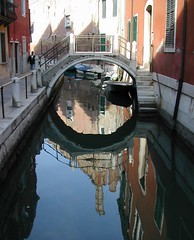
Typical bridge in Venice
A random bridge in Venice
Originally uploaded by udge.
Consider the photo on the right, a typical situation. There are seven steps leading from the street to the peak of the bridge, since each step is (from memory) about 16cm, the total rise is roughly a metre. Wheelchair ramps are fairly flat, up to a maximum of 10°; the length of ramp needed is therefore 5.7 metres or 18'8" (this is in fact quite steep, the normal angle is 6° for a length of 9.5 metres or 31'2"). Look at the photo, note that the front doors of the houses opposite the bridge open directly onto the pavement, and then tell me where you would put an eighteen-foot-long ramp? Can't be done. And now consider this: I was standing on another bridge when I took the photo. Where would you put its eighteen-foot-long ramp?

I'm not against provisions for the disabled, but I am for commonsense and the use of the eyes and brain that the Deity gave us. Laws exist to improve our condition, not simply in order to be obeyed.

Labels: ,

Saturday, October 28, 2006

Drunk blogging

Hello and welcome, my dears.

It's 2:13 am Saturday morning / Friday night and I've just got home from an impromptu party-type event, my hands smell of perfume and cocoanut oil. Ageing Yuppie called me up three hours ago to ask whether I wanted to drop in for a drink. I said no (too tired, too late) so he handed the phone to Jana, the young (very) woman who is subrenting his apartment while he is at the college Oop Noorth. She said that it's her birthday, I should please come by for a glass to celebrate. Such an invitation is of course compulsory, one may not refuse a birthday drink. Three hours and far too many glasses later, I'm home again drinking water and cooking hot chocolate (the party continues without me).

Jana is Russian, studying something that I can never remember, pretty and sweet and very high-maintenance. She requires constant attention: not just that she dances on the table but that we must all watch and applaud. It's at moments like this that I realize that I am indeed getting older: the young have so much energy, and they waste it on such futile things! Pascal famously said that our miseries derive from being unable to sit alone in a quiet room, and this is something that one can hope to acquire with age. (AY hasn't got there yet, he is if anything even more frenetic than when we met twenty years ago.)

Still, a happy and pleasant event. It's nice to associate with the young once in a while, strenuous as they are. I got into a long discussion with a marketing type from a Quite Well-Known Automobile Company about the meaning of life, and why he is unhappy in a job that contradicts all of his ideals, values, hopes and ambitions. Well. I tried as politely as possible to suggest that maybe his unhappiness is a thing worth noticing, and that the discrepancy between his job and his ideals etc might just worth considering. What benefit it a man that he gain the whole world but lose his soul? to coin a phrase.

Actually it's not about age as such. (Stop reading, please! The drunkenness has turned from merriment to pontificating (an interesting word, actually: "to speak like a Pope." Before the Reformation, when the whole of Christianity was Catholic, it must have been the highest of compliments).) Jana is probably no younger than Noorster who said "Given a choice, I'd rather watch an interesting biopic on TV than go out to drink alcohol and rub up against strangers" and "if I fall asleep after midnight, I'm knackered the next day." N has already figured it out, while J and AY are still worrying about the externalities.

Enough. Sweet dreams be yours, my dears, if dreams there be.

Labels: , , ,

Sunday, October 22, 2006

On sales and trade shows

Not that you'd know it from yesterday's post, but I was in Munich all day teaching my colleagues the finer points of the database system that they have allegedly been selling for six months / two years respectively, in preparation for our appearance at the Art Cologne trade show next month.

It's odd, I have this image of myself as a non-salesperson, could not and should not do sales, not my thing at all; however I must say in all modesty that I am a far better demonstrator and salesperson than either of them. It's clear that neither Georgette nor Biff has ever worked a trade show before, which is not surprising because it is a pretty unnatural thing to do; what does surprise me is that equally clearly neither of them has ever been to a trade show as a visitor.

How can this be? Tell me, if you wanted to open a restaurant, would you not go eat in a few restaurants first?

I learned to do trade shows by being a visitor at trade shows, it was part of Great Big Computer Company's policy that everyone on the stand had a day off-duty during the week, in which they would turn up in dirty jeans and walk around and look at the show - not the other stands, but the show itself: what kind of things do visitors do, what is it that makes them stay somewhere rather than walking on. It was a great training, watching and learning from those interactions was what made us such a successful team.

Well, Georgette and Biff haven't had that experience, so they simply don't know how trade shows work. They hadn't even understood that they must give the visitor a reason to bestow her time and attention on them, must show her something - look look, a piece of data! - within seconds of her arriving on the stand. They weren't even planning to take copies of the sales brochure to give away! Ye gods, it is to despair. And my income depends on them.

I changed the plan after half an hour of listening to the sort of questions they were anticipating being asked - none of which would ever occur at a trade show, with its walk-by casual visitors - and instead taught them how to do trade shows, with the database as the example. It's an uphill battle, what I wrote this summer is still true:
You have to find out what the (possible) customer wants.

People don't buy features, they buy solutions. They buy "make my problem go away."

Sounds obvious, doesn't it? But I cannot persuade my partner or his assistants to do this. They seem to believe that the customer has to be driven to the sale with pointèd sticks like a sacrificial lamb to the altar.

What I had to say is just basic commonsense, but it is counterintuitive to people who haven't worked a trade show before. A trade show is not at all like giving a demonstration to a possible customer, it is a specific environment which enforces a specific kind of behaviour on exhibitors and public alike. A customer getting a demo in her own office has made time for you, there are no distractions, no interruptions and no competition for her attention. She wants to know every detail of the product, because she is there for a reason: to decide whether or not to buy.

Trade show visitors are not "customers." They did not go to the show to look at your product! Unless you prove otherwise, you are just one more irrelevant distraction among the hundreds of stands. The visitors stream past at a steady pace, and you may consider yourself lucky if they even slow down at your booth. They are surrounded by distractions and interruptions, and the second they leave your stand they will encounter something even more shiny and exciting. (This is why they MUST take a brochure home.)

You cannot spend a minute explaining how the data is structured, while nothing changes on screen! They'll walk away. You MUST show them the three most important parts of the database, and demonstrate how these link together (look, I click here and this opens up there) within sixty seconds, else you've lost them. If the visitor stays with you for more than two minutes, and most of them won't, then you can go back to the beginning and talk about the details and the structure. But you have to earn their attention first.

Most important of all: it's not a lecture hall, you must engage the visitors! Ask them questions, listen to the answers, show them how the product solves their problem. In my experience, if you can get a visitor to talk for say forty seconds (in total) during the first two minutes, she'll stay as long as you want. People love interaction, we want to be listened to, we want our questions to be answered and our needs to be addressed. If you, salesperson, can do that, then you might turn this visitor into a customer.

Damn, I should be giving courses.

So anyway I was indeed in Munich yesterday. I spent today rather gently, trying not to have a headache, walking on the Blauer Weg as far as the greenhouses. It was a fine day, sunny and warmish, with a gentle breeze which made me think of the South of France. Holiday is a state of mind, not a place: I was on holiday this afternoon.

In related news I forgot to mention the most significant aspect of the visit to Munich (and what would Papa Sigmund say about that?) According to my partner, the Hobbyists are dragging their feet: rather than putting copies of the database into every shop, they now want to fit out "one to four stores" as a test. Well, that's just absurd. What is the point of putting us into their catalogue (which was part of the agreement) if Hobbyist's customers cannot then buy the advertised product? I infer that they intend to reneg on the catalogue too. [Updated: they did.]

On the other hand, the Hobbyists still expect to be granted an 80% markup.

Our development and production costs are basically fixed, it costs nearly as much to print up 25 copies for these four stores, as it would to print a thousand copies. Were they to stock all stores at once, as originally stated, that would cover our production costs plus leaving us reserves for the next production run. If they order only a handful, then we still need to pay all of the development costs right now, plus the dilemma of how many copies to produce. It's a huge amount of money.

We pay all the costs and take all the risks, and they expect to earn the same profit as though they too were taking a risk.

I think I would be ashamed to make such a proposal. That's probably why Hobbyist is rich and I am not.

Partner stated that he would "have to reconsider his involvement" if the Hobbyists back down.

Fuck fuck fuck.

Labels: , , , ,

Friday, July 07, 2006

Music between pedantry and joy

DM recently asked, "What is your favorite classical music piece?" in a comment; in response I wrote a piece which I took down the next morning, because it sounded too schoolmastery and show-offish: form an orderly queue to admire my knowledge of music. Well, really.

I had blathered about the different forms of "classical" music and comparing carrots to hammers, the impossibility of comparing a symphony to a set of Lieder. All quite true; but balderdash none the less.

There is a single, very simple answer to DM's question. My favourite classical music piece is Beethoven's "Emperor" concerto, the fifth Piano Concerto in E-flat major; to be really specific, the slow second movement. This is the ne plus ultra of music, everything else - even Wagner, even Mozart, even Schubert and Robert Johnson and Steely Dan - jostle for the also-ran slots behind Opus 73. This is it.

This piece is just pure joy, the distilled essence of happiness in 3/4 time. It raises my spirits; it makes me smile and sometimes laugh out loud in the street. I recommend the Sony Glenn Gould edition: GG was twenty-seven years old when this was recorded, playing like a young god, playing as though it were not previously composed by LvB but simply arriving through his fingertips in the room. It's a magnificent performance.

What do I like particularly well (in the classical vein)?

Beethoven's other piano concertos, string quartets and symphonies (in that order).
Arvo Pärt's modern classical religious music, especially the Passio (by coincidence, Tim Bray wrote about Pärt recently).
Schubert's Lieder, especially the Winterreise.
Mozart's operas, particularly Don Giovanni.
Wagner's operas, particularly Parzifal and the Ringzyklus.
Philip Glass' opera Akhnaton.
George Gershwin's An American in Paris - or is that jazz?
Respighi's Fontane di Roma and Pini di Roma.

While writing this post I bought "It's only rock 'n' roll" by the Stones on iTunes. This was the first piece of rock music to enter my consciousness, in July of 1974. I still remember vividly hearing it on the radio of a taxi, on the way from Heathrow airport to London, and seeing the title sprayed on the side of a bridge as we drove under it.
If I could stick my hand on my heart
Spill it all over the stage:
Would it satisfy you, would it slide on by you,
Would you think the boy is strange?
But that's another story for another bedtime.

Labels: , ,

Friday, May 26, 2006

On punctuality

Waiting for G and U to call, so that we can go to lunch (I only work there afternoons). G said they'd call "just before 1pm," well it is now 1:28 and I'm still waiting. This is absolutely typical of them, particularly of him: no more sense of time than a blind man has of watching television. They are late for 99 out of every 100 meetings, by up to two hours; and not just with me, they even treat their clients this way.

Try as I might, I cannot explain to them that it's not about a particular point-in-time, but about trust and reliability. I don't care in the least whether we meet at 1pm or at 1:30, as long as I know when we will meet. Had G told me, "we'll call at 1:30" I would have been just as happy - provided that he then did so. It's like a train timetable: I don't care at all how long the journey takes, provided that it takes no longer than is stated in the timetable.

Habitual lateness is an insult: it implies that my time is of no value, that I could have nothing better to do than to wait for them.

Labels: ,