Saturday, October 03, 2009

Awake

Woke at 5:15 from a strange dream, waiting now for hot chocolate to cook. I left my working glasses in the office last night, so forgive the typoes.

I was in SL, talking about unhappiness with Beta (from the wedding party). I decided to visit them at their RL home, which was not suburban Milwaukee but a cottage rear the river Thames in the village where AH lived. Beta was in the garden, sitting under trees at the end of an ancient, crumbling red-brick wall (not sure where Noctis was in the logic of the dream). We talked for a while there, then the scene changed and we were walking down curving streets of north London, near Highgate Cemetery, talking about a book that zie had written; then we were back indoors and zie showed me hir latest rejection letter: a YouTube-type video by e-mail from a school principal. I replied that it was wonderful that zie had written a book at all, and not to be worried about rejections. I told Beta about my father and the realities of the publishing business, and somehow the dream changed to farming! I was a self-aware cow, walking around a farm talking to other animals and looking at the new barn being built to replace one that had blown down in a storm. The place where it had stood was occupied by the house my favourite cousin grew up in, which was now painted yellow and in use as a Portuguese restaurant (yes, in the midst of the farm); by this point I was in my human body again. The owner was possibly a disguised AH since there was a dog that held my hand tightly and pulled on it to get me to play, and the other people (guests?) reminded me of his friends after Pat died.

Speaking of books, I am 200 pages into my second reading of Infinite Jest, and am both appalled and amused to realize how much I missed the first time. IJ really does need to be read twice, at least, to understand it. The thing is full of clues and hints about what is going on, but these can only be recognized as such by someone who already knows the story. Fascinating. I'm enjoying it even more this time around. Highly recommended to patient readers with a lot of time on their hands.

Labels: , , , , ,

Wednesday, June 11, 2008

London, day six

Hot and humid despite cloud cover and occasional drizzling rain. Miserable weather, too cool for just a t-shirt but so muggy that I sweat like a pig. I'm not sorry to have left this weather behind, not that summers in Stuttgart are that much more comfortable. Debating whether to shower again or just go out dirty this evening; tending to "dirty."

Walked around town by myself today, bought five books and spent a few hours in the British Museum's marvellous Greek collection. The Parthenon Marbles (formerly the Duveen Elgin Marbles) are thought-provoking in a way that was never intended because never envisaged. On the one hand, they are clearly the relics of a magnificent work of art, one of the masterpieces of human creativity; on the other hand, what one actually sees is a handful of garbage: scraps and shards and broken pieces. I remember reading somewhere that the ancient Greeks would have been appalled by our reverence for the Venus de Milo (and by extension these remnants), because they abhorred incompleteness and imperfection and decay. Nonetheless, it's a wonderful sight, and the Duveen gallery is a quite exquisite work of architecture; I encourage any visitors to London to see the marbles (admission is free, by the way).

Dinner this evening with Oscar and BB from my trip in March. My parents are still out in the countryside with my father's cousin; we will meet on Thursday evening, then split up again Friday morning early.

We all went yesterday to the village where AH had his post office, to speak with "the girls" (his former staff, the new owners, who took over the shop) and see the tree and bench placed in the local park in his memory. A kind of closure was had, I think, which is good. My father did not get AH's wartime flight logs, of course, but he did at least get the book of condolence that was set out in the post office and signed by pretty well the whole community after AH died; and the girls gave my parents a box of silver plate items that were found in his attic. I'd never seen any of these things before, and I was often in his apartment while Pat was alive and they were still entertaining. Will any of us ever use these things? probably no more than AH and Pat did. Anyway. I have a teapot and cream-and-sugar set, and am wondering how to get them through customs — and more seriously, how to get them to Germany at all. Other things will go to Sis, and our parents have a second teapot and other stuff. The cash value is next to nothing, I would guess, being after all silver plate not sterling, but it is a kind of reminder.

The question of AH's expenses, and with it the settlement of his will, has finally been laid to rest. Between the sale of the goodwill and stock to "the girls," and calling in some debts that AH never got around to billing, the estate has finished up with a clean "black zero," i.e. nothing left to disburse, but no debts either. Given the way things looked at first sight, this has to be counted a good outcome. (The girls were scathing about NJ's handling of the settlement, by the way, so perhaps Dad's cousin was right. Ach, who knows, and who cares, and what would it matter? It's over.) Vale, AH.

Labels: , , , ,

Friday, February 09, 2007

Friday

Walking home at sunset, it occurs to me that the Jews were right about that too: it's just obviously the correct and fitting time for the Sabbath to begin. It was a pleasure and a delight to be walking home in the fading daylight, as the shops were closing for the evening and the birds were giving their end-of-day songs.

Speaking of the Sabbath reminds me of something I forgot to mention earlier. When I was in Düsseldorf for four hours between trains last month, I walked around the Altstadt and on impulse stopped in at a church. There was only one other person there, a man in a wheelchair who sat at the back as though waiting for someone, yet paid no attention to me or his surroundings. I sat in a pew near the front and thought about life and death and the whole damned thing, then lit a candle to the memory of AH and watched it burn for a while. I remembered a morning many years ago when I was a student in London, working on a project about the (Roman Catholic) Westminster Cathedral—not to be confused with the (Anglican) Westminster Abbey—and stopped in one morning on my way to college to have another look at the building. I noticed a man going from altar to altar, praying and lighting a candle at each one; he made no attempt to stay the tears that were flowing down his cheeks, literally dripping from his chin as he prayed. I watched him with an odd feeling of awe and respect, and realized that I envied him his belief.

In other news The world is once again spinning around towards Spring, the sun touched the rooftops across the street at 8:15 this morning. I saw a tiny plant growing in a crack in a south-facing stone wall which was already flowering. Photos tomorrow, if I remember where it was.

In other, other news I bought myself another little toy, an Airport Express station so that I can hear my iTunes playlists through proper speakers. It's very nice. Setup was easy, once I figured out that my firewall was blocking the Airport from asking for instructions; and to give Apple their due, this was the first suggestion in the troubleshooting section of the manual. A look at the TCP logs reveals that I've already sent over four gigabytes of music wafting through the air in this way. Dear me, how time flies: a gigabyte used to fill a very large, heavy and expensive physical disk.

I was amused to discover, while configuring the system, that there are three unprotected WLAN networks available from where I sit, so I need never pay excess-volume charges again. Not that I would do that, of course.

In related news Philip once asked whether I could post an MP3 of a song that I had written about. Well, I found a service that does exactly that with exemplary simplicity: choose a file, set its expiry date, click on "upload," note the resulting URL. Here is a test, a 5 megabyte MP3 of my current most-often-put-on-repeat song. Don't delay, it's only there until 22:30 CET on Saturday.

What I haven't yet figured out, is how to tell you what it's called and who's playing without leaving a google-trail here that the copyright police could follow; and I would ask any commenters to please refrain from mentioning any such info. Anyone wants to know should mail me at the address up top, and I'll send you all the details.

[Updated] the solution is obvious: Amazon to the rescue. But please: mention no names.

Labels: , , , ,

Monday, January 08, 2007

You work hard all your life...

My cousin NJ, son of the late BJ, is executor of AH's will and has reported on its contents. Twenty percent of the estate goes to NJ, and the rest to the late BJ—in other words, to the greedy, grasping, manipulative bitch who is BJ's widow. There was no mention of my father nor even of BJ's other child in the will. And with that the story ends, goodbye flight logs. (It would have been hard enough to take possession of them had we been there.)

Except that the story doesn't end there.

My father wrote an eulogy which will be read by his cousin (who, by the way, tried to get my parents to engage a lawyer to challenge NJ's handling of the estate. Pah) at the funeral on Thursday, and he sent me a copy. He mentions playing in the street with friends when AH came home one day from work, and gave them a few pennies—a fortune then, of course, in a child's eyes—to buy sweets, and said that this was typical of the man. True enough, that is how I knew him: generous to a fault.

Well, that happened in 1936. AH was born in 1922. We count on our fingers and discover that AH was a "working man" at age fourteen if not earlier. (Given the methods of the English school system at the time, he probably left at age twelve.)

AH worked at least six days a week for at least seventy years.

Where did it get him? How large was the fortune that AH accumulated in those seventy years of daily toil?

In all probability he has left a bankrupt estate. Certain is that he owned no property, the shops and their residence were rented (which I never knew); that his bank accounts were practically empty (he borrowed £2,000 from my parents a few months back); and that he owed £10,000 in back rent. He left two businesses (small local shops) which in theory could be sold, if one could find a buyer, and an enormous collection of jazz LP's in near-mint condition. The accountant is still working on the details, but the general picture is clear and grim.

Poor AH. First Pat died before they had taken even one of the retirement trips they planned, then ... well, we shall never really know what happened then. My presumption is that he discovered that selling the businesses would not cover his retirement costs, and so was trapped into continuing to get up at 4am seven days a week to sort newspapers.

Which is, of course, just my interpretation; and I haven't seen him since about 1998 so I can't really speak for his state of mind. I cannot believe that anyone who owes that amount of money, and lives with that amount of uncertainty, can be happy and content (though I readily believe that people who owe many millions sleep quite well at night). I think that I would be miserably unhappy were I in that position (which God forbid!), and it saddens me beyond words to remember him in his mid-fifties, throwing a stick for the dogs to chase in Bushey Park or shaking hands with the musicians in Ronnie Scott's, and then to consider how his life ended.

Labels: ,

Wednesday, December 27, 2006

Christmas in the Black Forest

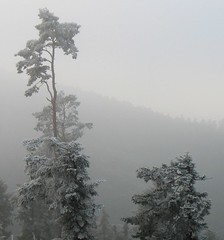
Fog and frost in the Black Forest
foggyValley_detail
Originally uploaded by udge.
Imagine, dear Reader, that this were the view from your living-room this Christmas. Not bad, eh? G's parents are lucky to live in a very beautiful area. It's quite high, 720 metres above sea level, therefore colder than Stuttgart and often windy; this time there was a constant and slow wind, very humid, which built up ribbons of frost along the upwind sides of basically everything. The newest photos on Flickr were taken on a walk after Christmas lunch, it was about 3° below zero, but the humidity made it quite unpleasant to be out. There was no snow at all. Only G's brother and I were brave and/or foolish enough to go out, the others lay about tenderly prodding their full bellies and planning the next meal.

Eating too much and drinking far too much is a truly international aspect of the way Christmas is celebrated. We ate five times between Monday noon and Tuesday mid-morning, then went to U's parents and ate thrice more on Tuesday. Eight meals in thirty-four hours. Not to forget the snacks, of course: the bowls of cookies and biscuits and chocolatey things that appeared whenever we sat elsewhere than at the dining table. I feel absolutely ill from all the sugary confectionery, my nerves are jingling from the endless cups of strong coffee. G's and U's parents would fit right in with my uncles and aunts in Saskatchewan (leaving aside the language problem).

In other news my uncle AH, my father's elder and last remaining brother, has died. He was 84, and until this year was in fine health (considering his age, weight and habits). He was a good man, I liked him well. He was generous with his time and money, whenever we met (the family when we were kids, myself when I lived in London) he would always ensure that the bill came to him. I spent many weekends with them when I was a student, we would take the dogs to Bushey Park on Sunday mornings for a run, and talk about history and the meaning of life. He was a world-famous jazz fan, known in the clubs of New York and Paris, personally acquainted with Duke Ellington; when the Duke's sister visited London, she stayed with AH and his wife Pat (they had no children). Like many Englishmen, he would volunteer the most intimate information about himself, but would deflect or ignore a direct question; conversation was always on his terms and at his choice of topic.

AH worked every day until he went into hospital this Spring for a minor ailment, from which treatment he didn't recover; he was readmitted in the Autumn and died in hospital. I am dreading calling my parents this evening; both for fear of how this setback will affect my father's condition—which is a post that I've been putting off since this summer—and, quite selfishly, in case they should ask me to represent them at the funeral and the reading of the will.

There's a bitter episode of family history behind this. My father's middle brother's widow is a greedy, grasping, manipulative bitch (if I may speak freely) and always was. She's also a babbing idiot, chatter chatter chatter chatter chatter chatter chatter chatter chatter chatter chatter chatter chatter chatter chatter and never a scrap more content than that. God knows how or why BJ, who was an educated and intelligent man, put up with her. Anyway. She got—took—all of our grandmother's furniture and photos, and has refused to let anyone in the family look at them since; my father is certain that the same will happen with AH's things. He (my father) has often said that he would like to have AH's wartime diaries and flight logs (he was in the Fleet Air Arm, flying Swordfish from aircraft carriers in the Atlantic); well, if Mrs. BJ knew that, she would claim them straight off—and probably throw them in the garbage.

I dread being asked to intervene in this grim and bloody business, one of the many pleasures of leaving London was the thought of never seeing Mrs. BJ again; but if I am asked I will of course go. We shall see.

Poor AH. Pat and the dogs will be waiting, she'll have just put the kettle on for tea.

Labels: , ,

Wednesday, August 23, 2006

Memories part two

Beth asked "what did YOU do in the summers, when you were, say ten?"

Growning up in Toronto, we divided our summers between home and visiting our distant relatives. In even-numbered years we would spend a month with my mother's family on various farms in Saskatchewan, and in odd-numbered years with my father's family in London (England); the other month we spent at home "relaxing" = working in the garden under Mom's direction, moving trees and relaying faux-cobblestoned walkways (you probably think I'm joking).


[I'm updating this piece by piece, adding links.]

England meant air travel, obviously: how else to get there? One could go by ship, of course, and many people still did even in the early Sixties; but we always flew. We travelled at first in propeller-driven Vickers Viscount airplanes, I remember seeing sparks shooting from the exhaust pipes at night. The planes had to refuel twice on the way to London: in Gander, on the coast of Labrador, and again in Paisley, outside Glasgow. The trip took a whole day, 23 hours door-to-door if I remember correctly. It must have been horrifically dull as there were of course no films or headsets in those days, but I cannot remember being bored (nor can I remember not being bored: Tout c'est vrai, mais rien c'est la verité to quote Albert Camus (from memory, feel free to correct me)).

England meant train travel. We were based in London with my grandmother in her three-storey six-room house (now long gone of course; the very street is gone, ploughed under and resown to use a metaphor from Saskatchewan) but we travelled far and often during the month we were there. We visited the great cathedrals (Winchester, Ely, Salisbury, Canterbury, York, Wells, Lincoln) and the sites of monasteries (Ripon, Rievaulx, Fountains Abbey), the university cities (Cambridge, Oxford and for that matter London itself), castles and palaces (Hampton Court, Windsor Castle, Hardwick Hall, Tintagel); all of them centuries old as Columbus set sail.

England meant being immersed in history, both formal antiquity and the lesser histories of family and "what happened next," being constantly in the presence of the past (to coin a phrase). History is a strange and intoxicating thing to a young and thoughtful North American, moving from the factory-fresh pastlessness of the West to an England that sometimes seemed to be nothing but past was akin to suddenly discovering a seventh sense or a previously unnoticed fifth limb; as when someone who grew up beside a small lake sees the Atlantic for the first time, it changes one's understanding of something (what water is like, how change happens) that had seemed so simple as to be not worth thinking on.

England meant smells, primarily the smells of combustion: coal fires, peat fires, wood fires, roasting chestnuts, diesel exhaust, jet fuel, incense. (A particular memory: walking down the hill from Auntie Maud's house to town to buy her groceries, we would pass a factory of some kind, where I would always stoop to look through a tiny barred window into a basement room where a man shovelled coal into the mouth of a glowing furnace. At the time (and in my defence I was about five years old) I found it fascinating to watch, but I was utterly detached from the scene: I watched him like an animal in the zoo, it didn't occur to me that the shoveller was a man just like my father, much less that with worse luck my father might have been that man. I was excited by the roar of the flames and the rattle of the coal flying off his shovel, and probably thought it a romantic and adventurous job.)

England meant fish, so many fish of so many kinds: sole, skate, plaice, flounder, zander, cod, eel, salmon, rock cod (aka dogfish), haddock, herring, sardines, whelks, winkles, mussels, cockles, crabs, trout, shrimp, crayfish; and of course the original takeaway fast food: fish and chips, wrapped in newspaper and dosed with salt and vinegar, best eaten with your fingers on the way home; the horror of gourmets and dieticians alike. We ate fish and chips in every city and town in England, and kept notes. Fish and chips is one of the few things I miss about England.

England meant colours: the red of brick walls and buses and telephone booths and Guardsmen, the yellow of crumbling stones, the deep inky blue of local trains, the glossy black of taxis, the matte black and startling sparkling white of Portland stone under the generations of sooty filth when St. Paul's Cathedral was cleaned, the many different greens, so lush and vibrant and intense, and of course the sea. What colour is the sea? it is all colours, all at once. There is no colour that you will not see in the sea at some time, under some condition of light and weather. Nowhere in England are you more than two hours' easy drive from the ocean, so one is constantly surprised by glimpses of the sea between buildings or from the crest of a hill. From the landing of the second stair of my grandmother's house, we could see the ships in the docks at Greenwich.

England meant family, my grandmother, my uncles and aunts; there were cousins in England too, my father's middle brother's children, but somehow we never really clicked. I could write a long post on Nanny (my grandmother) alone, she is the centre of a knot, a maze, a spiderweb of memories and associations. Because I associated with the generation(s) above mine, my English relatives seemed older than my Canadian ones, there were many great-aunts and -uncles (my grandmother's generation, she was one of eleven children) and their offspring (my father's cousins) and their offspring to be visited or met unexpectedly in train stations. I became aware of time as flow (and the paradox of rivers) in England, through living with this multi-generational family of long and overlapping generations. Generations in Saskatchewan were simple and discreet (in the sense of clearly separate), it was a surprise to learn that my grandmother's youngest brother was hardly older than my father; that made me reassess my relationship to my Canadian relatives.

England meant people, masses of people, more strangers than I had thought the world contained. We went to markets to buy fruit and vegetables and books and clothes (our parents) and to look at the people buying and selling (us kids). The concept of a market, of an individual person putting twenty-five apples and thirty pears on a table and going home when they were sold, was almost incomprehensible to kids raised in supermarkets.

England meant the War, which in those times and that generation actually meant the Great War, 1914-18. Every village had a War Memorial listing the names of the dead and the campaigns where the local regiment had fought; the officers had plaques or statues in the local church to their honour. Our family was scarred by the loss of Nip and Jack (my grandmother's older brothers) who simply disappeared in northern France in late 1917, just two among the millions who died there. (My father researched the regiment and recently found "the boys," both of whom lie in marked graves near Amiens, unfortunately long after Nanny's death.)

England meant the ready availability and casual consumption of alcohol (though not by us, God forbid). There were pubs everywhere, and though they were in fact always closed when you wanted a drink, they were nonetheless a significant social and cultural marker. Neighbourhoods were defined by the kind of pub they supported, whether sawdust floors and wooden stools, or panelled walls and sofas by the open fire. We stayed in many post house-type pubs; most of them were delightful to a child, with small stone-framed lancet windows, low broad doorways, odd half-staircases and back wings, and fireplaces that in midsummer were still redolent of coal.

England meant culture, we saw at least one play and heard at least one concert on every trip. We visited every museum and art gallery and historical building that we could find. If Saskatchewan was a place without books, England was founded on books, built of books. What struck me most about Oxford was not the river or the beautiful architecture, but the notion that there were so many books in the world that one needed to create special buildings just to keep them in. So many books! My older uncle and aunt had a newsagents and a bookstore in a small town by the Thames near Hampton Court, we used to read all the magazines they had and take a dozen books each home with us. God bless Penguin paperbacks with their cheerful orange spines, just to look at them makes me happy now, forty years on.

Labels: ,